A Complete Guide to Laboratory Freezers and Their Applications in Research
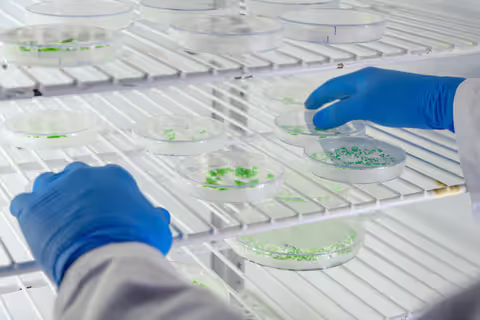
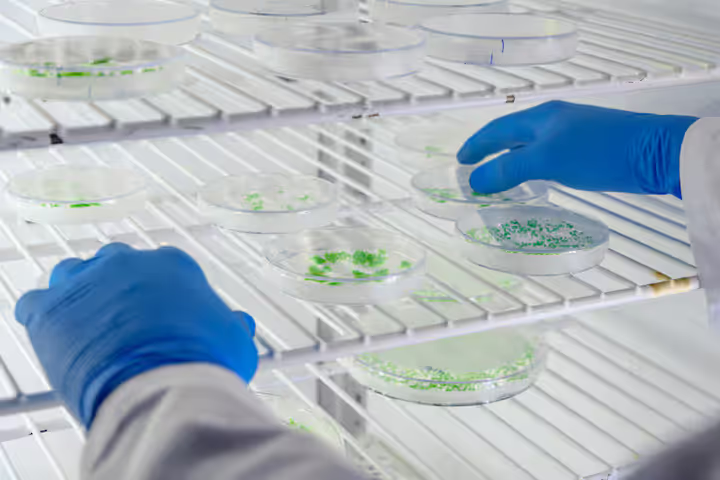
Laboratory freezers are specialized cold-storage units designed to maintain controlled temperatures far below ambient room level. They differ from ordinary household freezers by offering much greater temperature stability, often reaching ranges of –20 °C, –40 °C, or even –80 °C (and in some cases colder)—for storing biological samples, reagents, cell lines, enzymes, and other temperature-sensitive materials.
These specialized units are commonly used in biotechnology, pharmaceuticals, clinical diagnostics, and environmental studies. They help prevent sample degradation, ensuring that experiments and analytical results remain consistent over time.
Modern laboratory freezers range from standard models operating at -20°C to ultra-low temperature (ULT) freezers that reach -86°C or below. They are often equipped with monitoring systems, alarms, and energy-efficient compressors to maintain a consistent environment for critical samples.
Why Laboratory Freezers Matter in Today’s Research Landscape
The importance of laboratory freezers has grown as scientific research expands into molecular biology, genomics, and vaccine development. Maintaining sample stability is essential for reproducibility and credibility in experiments.
Key reasons they matter today:
-
Sample Preservation: Critical for DNA, RNA, plasma, enzymes, and tissue samples that degrade quickly at room temperature.
-
Research Continuity: Enables long-term projects, allowing researchers to store materials for future analysis.
-
Data Integrity: Stable sample storage reduces experimental variability and ensures accurate outcomes.
-
Safety and Compliance: Helps laboratories comply with biosafety standards and avoid contamination risks.
For instance, during the COVID-19 pandemic, ultra-low temperature freezers became vital for storing vaccine components. This highlighted how storage technologies directly impact public health and scientific innovation.
Who Benefits:
-
Academic research institutions
-
Biotech and pharmaceutical companies
-
Environmental testing labs
-
Clinical and diagnostic centers
Recent Developments and Trends in Laboratory Freezers
In the last few years, laboratory freezer technology has advanced to address environmental, operational, and safety concerns.
1. Energy Efficiency Innovations (2023–2025):
Manufacturers are focusing on eco-friendly refrigerants and variable speed compressors that reduce energy consumption by up to 30%. This aligns with global efforts to reduce carbon footprints in laboratory settings.
2. Smart Monitoring and IoT Integration:
Modern freezers now include cloud-based monitoring systems. These allow real-time temperature tracking and alert notifications via mobile apps. Such features minimize the risk of sample loss during power outages or system failures.
3. Ultra-Low Temperature (ULT) Enhancements:
Recent ULT freezers use hydrocarbon refrigerants instead of HFCs (hydrofluorocarbons), which are being phased out due to environmental regulations. This change improves sustainability while maintaining high performance.
4. Data Logging and Digital Control:
Advancements in digital control panels and automated data logging systems ensure transparency and traceability in research processes, especially in Good Laboratory Practice (GLP) and ISO-certified facilities.
5. Compact and Modular Designs:
New models are designed for laboratories with limited space, offering modular configurations and stackable options without compromising storage capacity.
Regulatory and Policy Considerations
Laboratory freezers are subject to several international and national standards to ensure sample safety and environmental compliance.
Global Regulations:
-
ISO 15189 and ISO 17025: Require precise temperature control and calibration for laboratories handling biological or chemical materials.
-
Good Laboratory Practice (GLP): Mandates proper equipment maintenance, calibration, and documentation.
-
UN Montreal Protocol: Promotes the elimination of ozone-depleting refrigerants in cooling systems.
Country-Specific Examples:
-
United States (EPA): The Environmental Protection Agency regulates refrigerants used in laboratory freezers under the Clean Air Act.
-
European Union (F-Gas Regulation): Sets limits on fluorinated greenhouse gases, pushing manufacturers to adopt eco-friendly refrigerants.
-
India (CPCB & MoEFCC): Laboratories must follow guidelines for chemical and biological waste management, which include proper temperature-controlled storage.
These policies ensure that laboratory freezers not only safeguard scientific samples but also align with sustainability and environmental goals.
Tools and Resources for Laboratory Management
Efficient laboratory freezer management requires reliable tools and systems for monitoring, calibration, and compliance.
Useful Tools and Platforms:
| Tool/Resource | Purpose | Description |
|---|---|---|
| Labguru | Inventory Management | Tracks stored samples and freezer capacity efficiently. |
| Thermo Fisher Connect Platform | Remote Monitoring | Enables real-time alerts and temperature tracking via cloud access. |
| Eppendorf eLABInventory | Data Logging | Provides secure documentation of sample storage history. |
| CryoTrack Software | Compliance Tool | Supports regulatory reporting and GLP documentation. |
| Energy Star Database | Equipment Selection | Lists energy-efficient laboratory freezers that meet EPA standards. |
Additional Tips for Researchers:
-
Schedule regular calibration and performance validation.
-
Maintain backup power systems for critical storage units.
-
Use digital labels and barcoding for efficient sample retrieval.
-
Monitor freezer temperature daily using automated logs.
Frequently Asked Questions
1. What is the difference between a laboratory freezer and a household freezer?
A laboratory freezer offers precise temperature control, uniform cooling, and alarm systems. Household freezers are not suitable for scientific use because they lack temperature stability and calibration features.
2. What types of laboratory freezers exist?
There are several types, including:
-
Standard freezers (-20°C)
-
Low-temperature freezers (-40°C)
-
Ultra-low temperature (ULT) freezers (-86°C)
-
Cryogenic freezers (below -150°C, often using liquid nitrogen)
3. How often should laboratory freezers be maintained?
It’s recommended to perform preventive maintenance at least twice a year. Regular checks include door seal integrity, temperature uniformity tests, and compressor performance evaluations.
4. Are there any energy-efficient laboratory freezer options?
Yes. Energy Star-rated models and hydrocarbon refrigerant systems significantly reduce electricity use and environmental impact.
5. How can temperature deviations be managed?
Laboratories should use monitoring software that triggers alerts during deviations. Backup units and emergency response plans are also essential for sample protection.
Conclusion
Laboratory freezers play a fundamental role in preserving scientific materials that support medical, environmental, and industrial research. Their design and function directly affect the reliability of data and outcomes across disciplines.
With the rise of sustainability initiatives and digital monitoring, the next generation of laboratory freezers promises greater efficiency, eco-friendliness, and connectivity. Researchers, policymakers, and laboratory managers must stay informed about new technologies and regulations to maintain operational excellence.